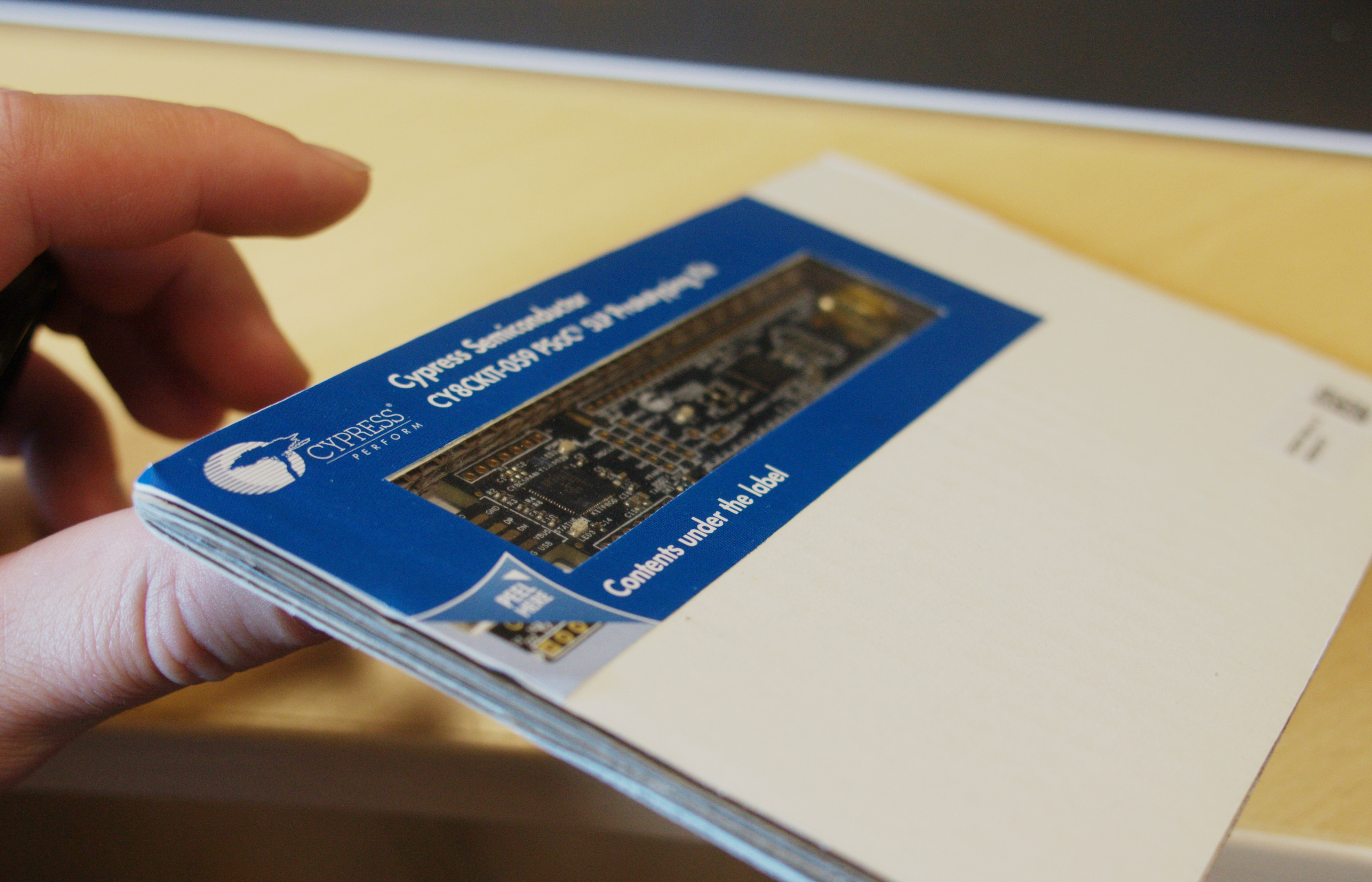
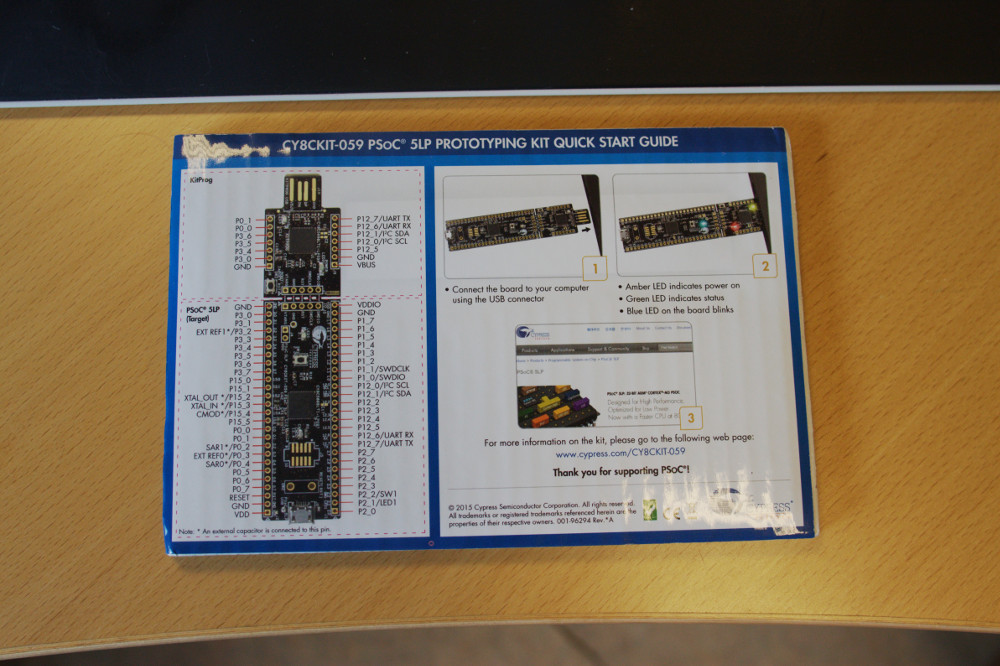
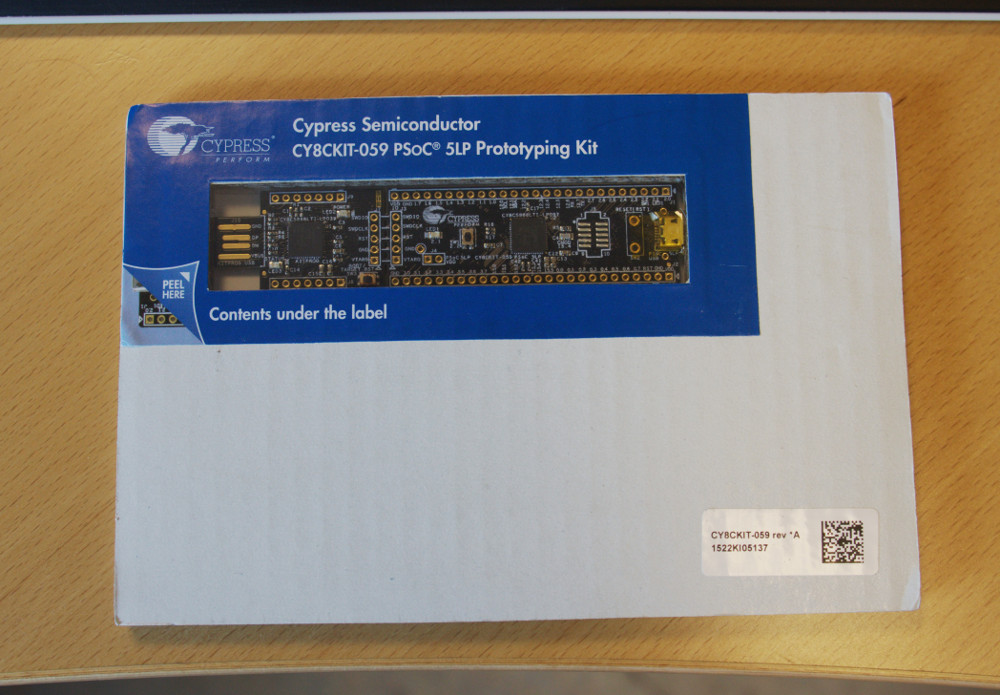
Love the packaging! I got this CY8CKIT-059 PSoC 5LP proto kit, and the CY8CKIT-049-42xx, the PSoC 4 proto kit, as they’re both super cheap, and they both came in rather excellent packaging. The pcb is behind a peel off window, in a cutout of a sandwich of three sheets of corrugated cardboard. The backside has a nice graphical layout with pins labelled, and some basic info on where to get more info. Very nice, compact, easy to ship, well done Cypress.
Of course, that’s about all that’s nice. The PSoC family seems interesting, I’ve been wanting to play with them for a while, but Cypress has absolutely zero linux support, and because of the configurable nature of the device, you really do seem to need to use their windows PSoC Creator tool. Allegedly once you’ve designed your system, you can edit the code portions freely, but it seems a long way off. OpenOCD has support for the flash in the PSoC 4 family, but nothing (yet) for the flash, and definitely no support for the KitProg programming dongle. That KitProg does seem like a nice bit of gear in it’s own right though, it’s USB2I2C, USB2UART, SWD debug adapter, on a little snap off portion of the board. However, even the USB2UART portion fails to be recognised as CDC-ACM in linux, presumably due to a bug in the descriptors. lsusb implies that they’re trying to be CDC-ACM. This one will have to be on the shelf for quite a while I’d imagine.
Full lsusb output for posterity here:
Bus 003 Device 011: ID 04b4:f139 Cypress Semiconductor Corp.
Device Descriptor:
  bLength                18
  bDescriptorType         1
  bcdUSB               2.00
  bDeviceClass          239 Miscellaneous Device
  bDeviceSubClass         2 ?
  bDeviceProtocol         1 Interface Association
  bMaxPacketSize0         8
  idVendor           0x04b4 Cypress Semiconductor Corp.
  idProduct          0xf139
  bcdDevice            2.0b
  iManufacturer           1 Cypress Semiconductor
  iProduct                2 Cypress KitProg
  iSerial               128 1C210338012E4400
  bNumConfigurations      1
  Configuration Descriptor:
    bLength                 9
    bDescriptorType         2
    wTotalLength          130
    bNumInterfaces          4
    bConfigurationValue     1
    iConfiguration          2 Cypress KitProg
    bmAttributes         0x80
      (Bus Powered)
    MaxPower              400mA
    Interface Descriptor:
      bLength                 9
      bDescriptorType         4
      bInterfaceNumber        0
      bAlternateSetting       0
      bNumEndpoints           2
      bInterfaceClass         3 Human Interface Device
      bInterfaceSubClass      0 No Subclass
      bInterfaceProtocol      0 None
      iInterface              3 KitBridge
        HID Device Descriptor:
          bLength                 9
          bDescriptorType        33
          bcdHID               1.11
          bCountryCode            0 Not supported
          bNumDescriptors         1
          bDescriptorType        34 Report
          wDescriptorLength      43
         Report Descriptors:
           ** UNAVAILABLE **
      Endpoint Descriptor:
        bLength                 7
        bDescriptorType         5
        bEndpointAddress     0x83  EP 3 IN
        bmAttributes            3
          Transfer Type            Interrupt
          Synch Type               None
          Usage Type               Data
        wMaxPacketSize     0x0040  1x 64 bytes
        bInterval               1
      Endpoint Descriptor:
        bLength                 7
        bDescriptorType         5
        bEndpointAddress     0x04  EP 4 OUT
        bmAttributes            3
          Transfer Type            Interrupt
          Synch Type               None
          Usage Type               Data
        wMaxPacketSize     0x0040  1x 64 bytes
        bInterval               1
    Interface Descriptor:
      bLength                 9
      bDescriptorType         4
      bInterfaceNumber        1
      bAlternateSetting       0
      bNumEndpoints           2
      bInterfaceClass       255 Vendor Specific Class
      bInterfaceSubClass      0
      bInterfaceProtocol      0
      iInterface              5 KitProg Programmer
      Endpoint Descriptor:
        bLength                 7
        bDescriptorType         5
        bEndpointAddress     0x81  EP 1 IN
        bmAttributes            2
          Transfer Type            Bulk
          Synch Type               None
          Usage Type               Data
        wMaxPacketSize     0x0040  1x 64 bytes
        bInterval               0
      Endpoint Descriptor:
        bLength                 7
        bDescriptorType         5
        bEndpointAddress     0x02  EP 2 OUT
        bmAttributes            2
          Transfer Type            Bulk
          Synch Type               None
          Usage Type               Data
        wMaxPacketSize     0x0040  1x 64 bytes
        bInterval               0
    Interface Association:
      bLength                 8
      bDescriptorType        11
      bFirstInterface         2
      bInterfaceCount         2
      bFunctionClass          2 Communications
      bFunctionSubClass       0
      bFunctionProtocol       0
      iFunction               0
    Interface Descriptor:
      bLength                 9
      bDescriptorType         4
      bInterfaceNumber        2
      bAlternateSetting       0
      bNumEndpoints           1
      bInterfaceClass         2 Communications
      bInterfaceSubClass      2 Abstract (modem)
      bInterfaceProtocol      0 None
      iInterface              4 KitProg USBUART
      CDC Header:
        bcdCDC               1.10
      CDC ACM:
        bmCapabilities       0x02
          line coding and serial state
      CDC Union:
        bMasterInterface        2
        bSlaveInterface         1
      CDC Call Management:
        bmCapabilities       0x00
        bDataInterface          1
      Endpoint Descriptor:
        bLength                 7
        bDescriptorType         5
        bEndpointAddress     0x85  EP 5 IN
        bmAttributes            3
          Transfer Type            Interrupt
          Synch Type               None
          Usage Type               Data
        wMaxPacketSize     0x0008  1x 8 bytes
        bInterval               2
    Interface Descriptor:
      bLength                 9
      bDescriptorType         4
      bInterfaceNumber        3
      bAlternateSetting       0
      bNumEndpoints           2
      bInterfaceClass        10 CDC Data
      bInterfaceSubClass      0 Unused
      bInterfaceProtocol      0
      iInterface              4 KitProg USBUART
      Endpoint Descriptor:
        bLength                 7
        bDescriptorType         5
        bEndpointAddress     0x86  EP 6 IN
        bmAttributes            2
          Transfer Type            Bulk
          Synch Type               None
          Usage Type               Data
        wMaxPacketSize     0x0040  1x 64 bytes
        bInterval               0
      Endpoint Descriptor:
        bLength                 7
        bDescriptorType         5
        bEndpointAddress     0x07  EP 7 OUT
        bmAttributes            2
          Transfer Type            Bulk
          Synch Type               None
          Usage Type               Data
        wMaxPacketSize     0x0040  1x 64 bytes
        bInterval               0
Device Status:     0x0000
  (Bus Powered)
$
The KitProg also has a bootloader of some form, if you hold down reset while plugging it in, though it times out and reboots normally after a couple of seconds idle.
Bus 003 Device 012: ID 04b4:f13b Cypress Semiconductor Corp.
Device Descriptor:
  bLength                18
  bDescriptorType         1
  bcdUSB               2.00
  bDeviceClass            0 (Defined at Interface level)
  bDeviceSubClass         0
  bDeviceProtocol         0
  bMaxPacketSize0         8
  idVendor           0x04b4 Cypress Semiconductor Corp.
  idProduct          0xf13b
  bcdDevice            1.00
  iManufacturer           1 Cypress Semiconductor
  iProduct                4 KitProg Bootloader
  iSerial               128 1C210338012E4400
  bNumConfigurations      1
  Configuration Descriptor:
    bLength                 9
    bDescriptorType         2
    wTotalLength           41
    bNumInterfaces          1
    bConfigurationValue     1
    iConfiguration          2 Configuration 0x0001
    bmAttributes         0x80
      (Bus Powered)
    MaxPower              500mA
    Interface Descriptor:
      bLength                 9
      bDescriptorType         4
      bInterfaceNumber        0
      bAlternateSetting       0
      bNumEndpoints           2
      bInterfaceClass         3 Human Interface Device
      bInterfaceSubClass      0 No Subclass
      bInterfaceProtocol      0 None
      iInterface              3 Interface 0x0001
        HID Device Descriptor:
          bLength                 9
          bDescriptorType        33
          bcdHID               1.11
          bCountryCode            0 Not supported
          bNumDescriptors         1
          bDescriptorType        34 Report
          wDescriptorLength      36
         Report Descriptors:
           ** UNAVAILABLE **
      Endpoint Descriptor:
        bLength                 7
        bDescriptorType         5
        bEndpointAddress     0x01  EP 1 OUT
        bmAttributes            3
          Transfer Type            Interrupt
          Synch Type               None
          Usage Type               Data
        wMaxPacketSize     0x0040  1x 64 bytes
        bInterval               1
      Endpoint Descriptor:
        bLength                 7
        bDescriptorType         5
        bEndpointAddress     0x82  EP 2 IN
        bmAttributes            3
          Transfer Type            Interrupt
          Synch Type               None
          Usage Type               Data
        wMaxPacketSize     0x0040  1x 64 bytes
        bInterval               1
Device Status:     0x0000
  (Bus Powered)
Hi,
I found your page while looking for the answer to the same problem of how to at least use the USBUART connection from LINUX to the CY8CKIT-059 KITPROG device. I found an answer for the USBUART that may be of use to you though the matter of using the programmer is something far beyond that. Seems like I read some comment this evening mentioning some one of the open software device programming utilities such as OpenOCD or maybe one of the others in reference to KITPROG but I don’t remember what it said whether it was lamenting that it did not work or suggesting that it is in the process of being supported or what. But you may wish to check into it. Since the HW design is open and the programming FW and algorithms are also open I suspect it should be possible that it could be supported for device programming (at least uploading the binary to the target and maybe also ARM SWD mode debug?) by some open tool chain. Anyway here is how I got the USBUART to work but I didn’t refine the process in any way from my first working configuration:
modprobe usbserial vendor=0x04B4 product=0xF139
minicom –baudrate 9600 –8bit –device /dev/ttyUSB1
#minicom –baudrate 9600 –8bit –device /dev/ttyUSB0
USB1 was the one that ended up passing target serial data to my minicom. I don’t know what USB0 is for.